Community ecology
We study how interactions among species build ecological communities, and how those communities respond when the world around them changes.
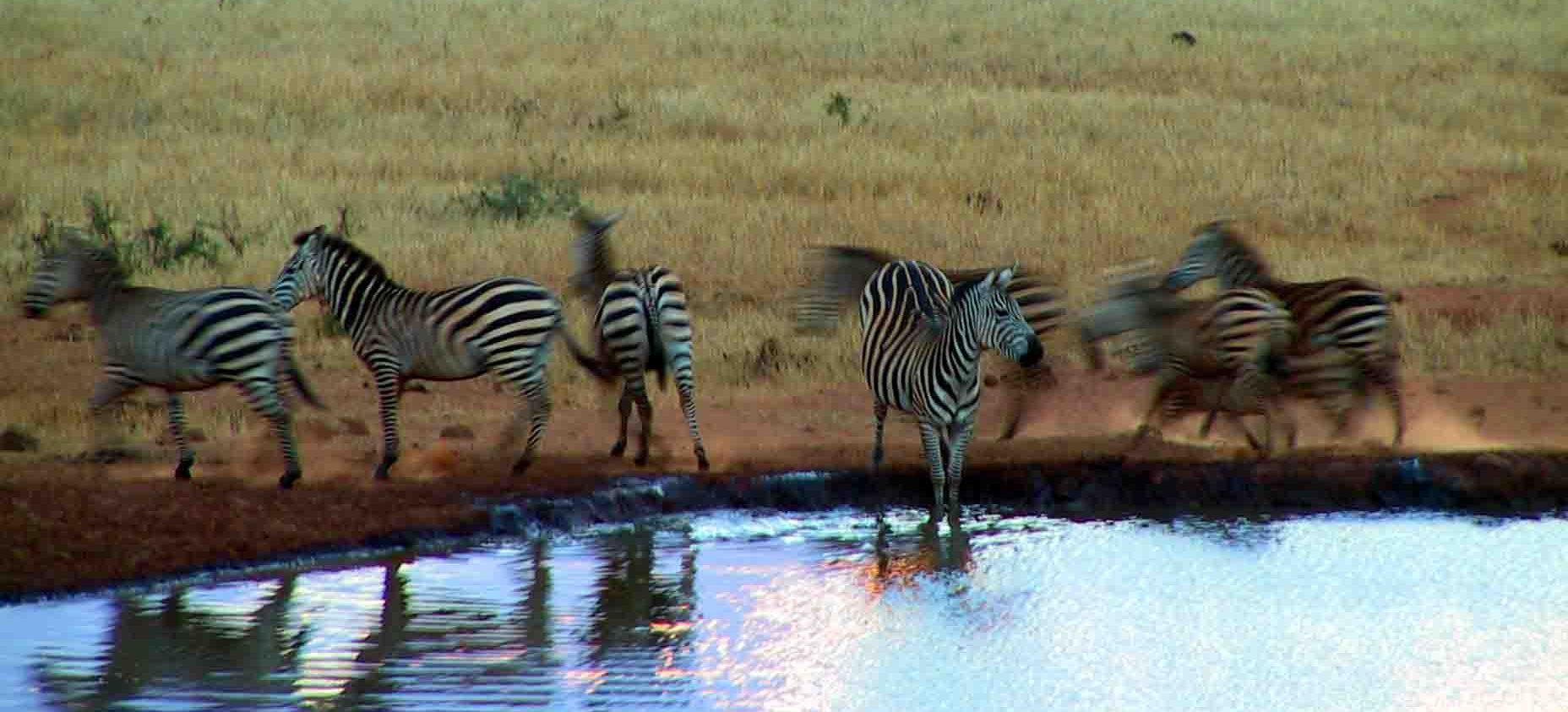
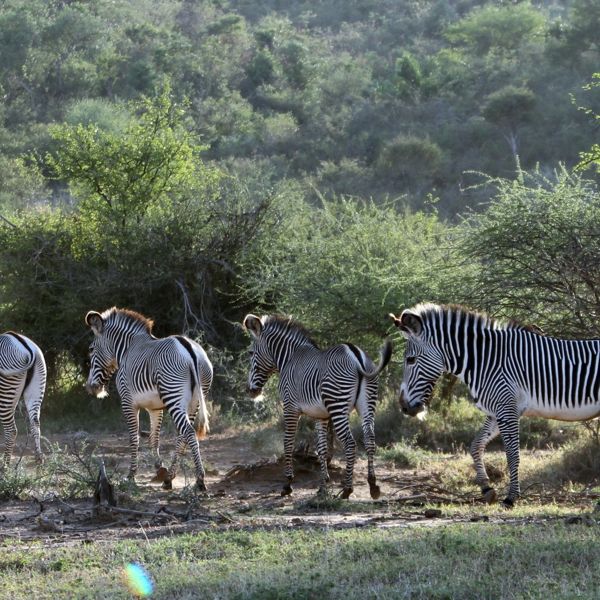
Mutualism, predation, competition and herbivory link species into networks whose structure governs how ecosystems work. Using long-term field experiments, mostly in East African savannas and also on Caribbean islands, we ask how these interactions are assembled and maintained, and what happens to whole communities when invasive species arrive, large animals disappear or the climate shifts.
Contact
Todd M. Palmer
Research Foundation Professor
Department of Biology
University of Florida
Gainesville, FL 32611
tmp@ufl.edu
Interested in joining the lab? Start here.
Recent papers
- Gijsman, F., C. M. Nutter, F. Erii, F. M. Khamis, F. L. Ombura, M. C. Hutchinson, T. M. Palmer, J. R. Goheen, S. E. Miller and R. M. Pringle. Importance of megaherbivores for dung-beetle biodiversity and ecosystem functions. Science 392:eaeb7062DOI (opens in a new tab)
Network theory predicts that losing highly connected species should trigger cascades of coextinction, but evidence from nature is scarce. We built an interaction network between 179 dung beetle species and East African mammals, then compared simulated elephant loss with a 15-year exclusion experiment and real-world elephant declines. Elephant dung was the network's most connected resource, and its loss reduced beetle diversity, biomass and dung removal, providing experimental evidence that elephants are true keystone species.
- Sakhalkar, S. P., … T. M. Palmer, … et al. Global patterns in plant–pollinator specialisation. Nature Ecology and EvolutionDOI (opens in a new tab)
Do plant–pollinator interactions become more specialized toward the tropics? Analyzing more than 3,400 quantitative pollination networks worldwide, we find no simple latitudinal gradient. Network and pollinator specialization peak near the northern tropical–subtropical boundary, plant specialization differs between hemispheres, and climate, especially temperature and precipitation, predicts specialization better than latitude or biodiversity, with strong differences among pollinator groups such as birds and insects.
- Wedel, E. R., A. B. Davies, J. R. Goheen, T. M. Palmer, R. M. Pringle and T. C. Coverdale. Large herbivores suppress tree growth but increase climate resilience in an African savanna. Ecology Letters, in press.
How does losing large herbivores affect savanna trees? Combining 16 years of growth data with measurements of leaf water potential and gas exchange in a Kenyan exclusion experiment, we show that removing large herbivores increases tree growth but also increases water stress, especially in dry periods. Species with the most acquisitive water use suffered most, suggesting herbivores make savanna trees more resilient to drought.
- Abraham, J. O., M. Stahl, S. Kurukura, A. A. Hassan, J. R. Goheen, T. M. Palmer, T. R. Kartzinel and R. M. Pringle. Impacts of large herbivores on savanna plant communities: predictive models of consumer selectivity and plant response. Ecology 107(7):e70445.DOI (opens in a new tab)
Can we predict how plant communities respond when large herbivores disappear? Using herbivore diet data, plant functional traits and size-selective exclosures in Kenya, we identified traits that predict which plants each herbivore group selects and tested whether selectivity predicts plant responses to herbivore removal. Plant responses depended not only on being eaten but on traits and plant–plant interactions, refining simple first-principles predictions.
- Louthan, A. M., E. M. Lombardi, J. R. Goheen, T. M. Palmer, and D. F. Doak. Trees facilitate Hibiscus meyeri, a common savanna forb, via multiple mechanisms. Journal of Vegetation Science in press.